
VolatilePair Hook is now live on Ethereum mainnet, starting with ETH/USDC. It’s a new Uniswap v4 dynamic-fee hook built for LPs, with fees that follow the market.
Volatile pairs did more than $500 billion in volume on Uniswap this year. Unlike stable pairs, they don't trade around a fixed price. With a static fee, LPs absorb any price move the fee doesn't cover. VolatilePair Hook adjusts fees with each move, so LPs keep more of the value they create.
How VolatilePair Hook works
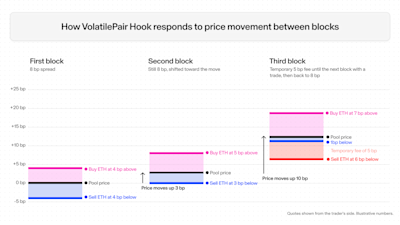
A static-fee ETH/USDC pool charges the same fee whether you're buying ETH or selling it. When ETH jumps on other markets, the pool quotes the old price. Whoever gets there first buys cheap and keeps the difference.
VolatilePair Hook uses recent price moves to set separate fees for buying and selling, recalculated on every swap. It's built to keep value in the pool while quoting a competitive spread:
- When the pool's price rises, buying ETH costs more and selling it costs less. When it falls, the fees flip.
- After a big price move, trades that push the price back pay a temporary fee.
 VolatilePair Hook is designed to evolve with usage. Pool parameters and fee logic can be upgraded through Uniswap Governance, so the mechanism improves without pools needing to migrate.
Markets built for how assets trade
Hooks let every pool set its own fees and pricing logic. In September, StablePair Hook introduced dynamic fees for stable pairs. Within four weeks, StablePair pools did $3.1 billion in volume across Uniswap. Now, we're bringing dynamic-fee hooks to ETH/USDC and other high-volume pairs.
VolatilePair Hook joins StablePair, Permissioned Pools, and LitePSM, with more hooks on the roadmap. Learn more about hooks built by Uniswap Labs.
Get started
- Liquidity providers: port liquidity to ETH/USDC
- Swappers: explore and swap in the Uniswap Web App and Wallet
- Issuers and builders: get in touch for support building a custom hook