
Wall Street runs on order books. The SEC's Innovation Exemption requires an AMM on a public blockchain.
On September 17, 2026, the order granted a five-year exemption for a newly defined category of venue, the Tokenized Securities Venue (TSV). TSVs trade tokenized NMS stock through permissioned liquidity pools. If they meet the order's conditions, they don't need to register as exchanges or alternative trading systems, and liquidity providers that comply aren’t considered dealers.
To date, more than $20 billion in stock tokens has traded on the Uniswap Protocol. Most of this volume comes from products like Robinhood Stock Tokens and xStocks, along with issuers like Ondo and Dinari. Exposure is already onchain. Shareholder rights could be next.
U.S. stocks are a $79 trillion market. Automated market makers (AMMs) will change how those assets trade, who provides liquidity, and who gets to create markets. Here's our read on the order, and what it means for teams building on the Uniswap Protocol.
AMMs upgrade markets
AMMs automate most of the work done by professional market makers. People can provide liquidity by depositing assets directly into a smart contract. This opens up who can make markets, increasing competition and creating new paths for issuers to build liquidity. Pools run 24/7, enabling trading on nights, weekends, and holidays. AMMs are already used by thousands of interfaces around the world, creating immediate global distribution for any market that is created.
AMMs also expand what assets can trade against. Take a stock like NVIDIA. On exchanges, it trades against dollars. Onchain, it could trade against a tokenized S&P 500 fund, a money market fund, or crypto. Pairing assets that move together, like NVIDIA and the S&P 500, can reduce relative price risk for liquidity providers. Traders can still buy in from any asset, using automated routing systems.
Now we can see these markets taking shape. In August, ten tokenized stocks and ETFs started trading against SPY on Robinhood Chain. Three months later, more than 40 have SPY pools, with over $900 million in volume across 130,000 wallets.
Demand for onchain stocks is real, and growing. TSVs give institutions a new way to meet it.
How TSVs work
TSVs provide AMM pools for approved participants, on a public, permissionless blockchain. They have lighter regulatory obligations than exchanges, and liquidity providers (LPs) don’t need to register as dealers.
Running on an AMM means settlement works differently, too. Today, a broker routes your order, an exchange or wholesaler executes it, and clearinghouses and depositories handle settlement. On a TSV, both sides of a swap settle in the same transaction, or neither does.
Companies have a say in whether their stock trades on TSVs. TSVs have to give issuers 30 days notice and a chance to object. Once a stock is listed, any app that connects to the pool can offer it to approved users.
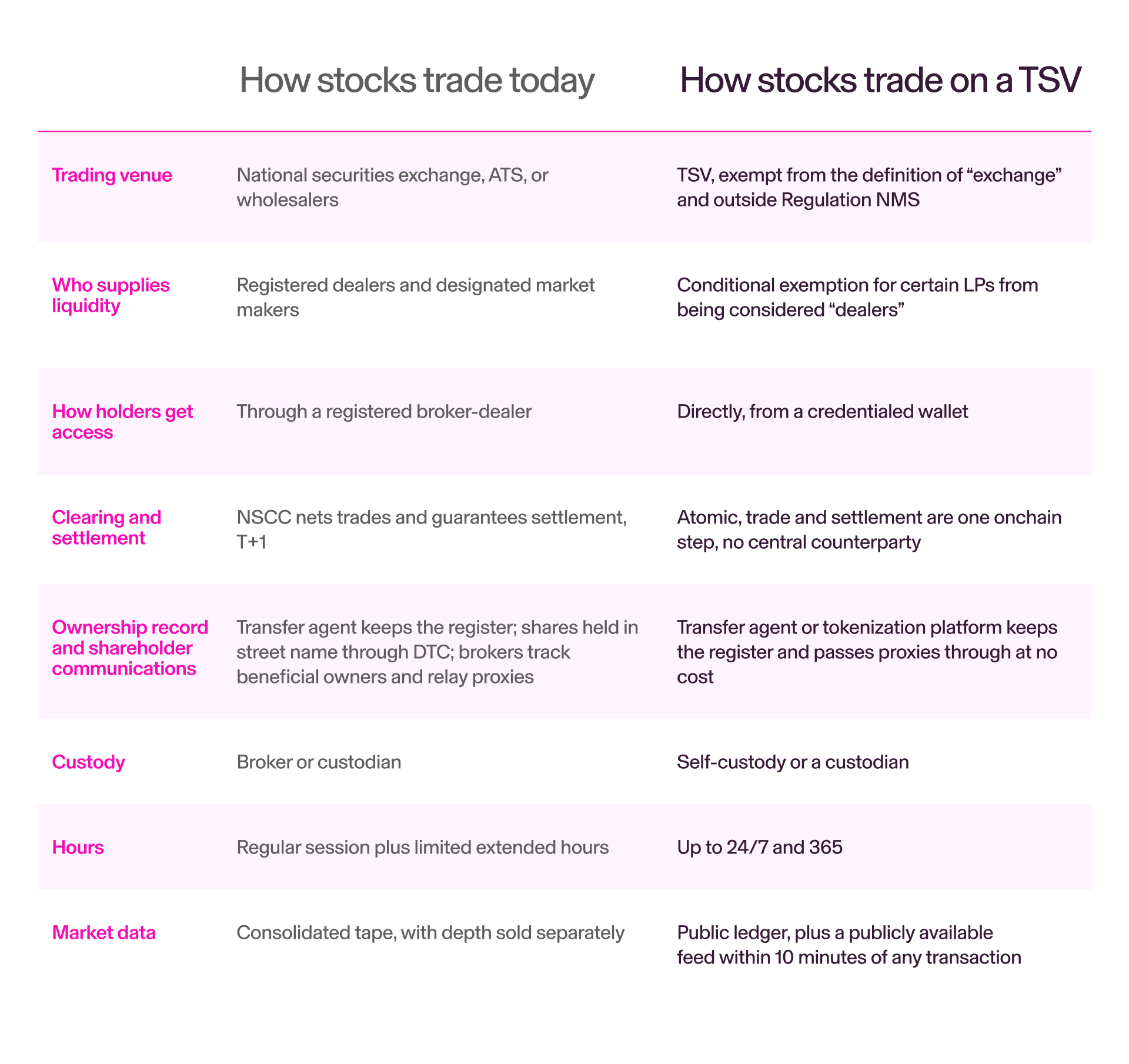
To qualify, venues have to meet a set of conditions, including public fee disclosure, access controls, symbol and volume caps, and trading halts. So how do you enforce those rules onchain?
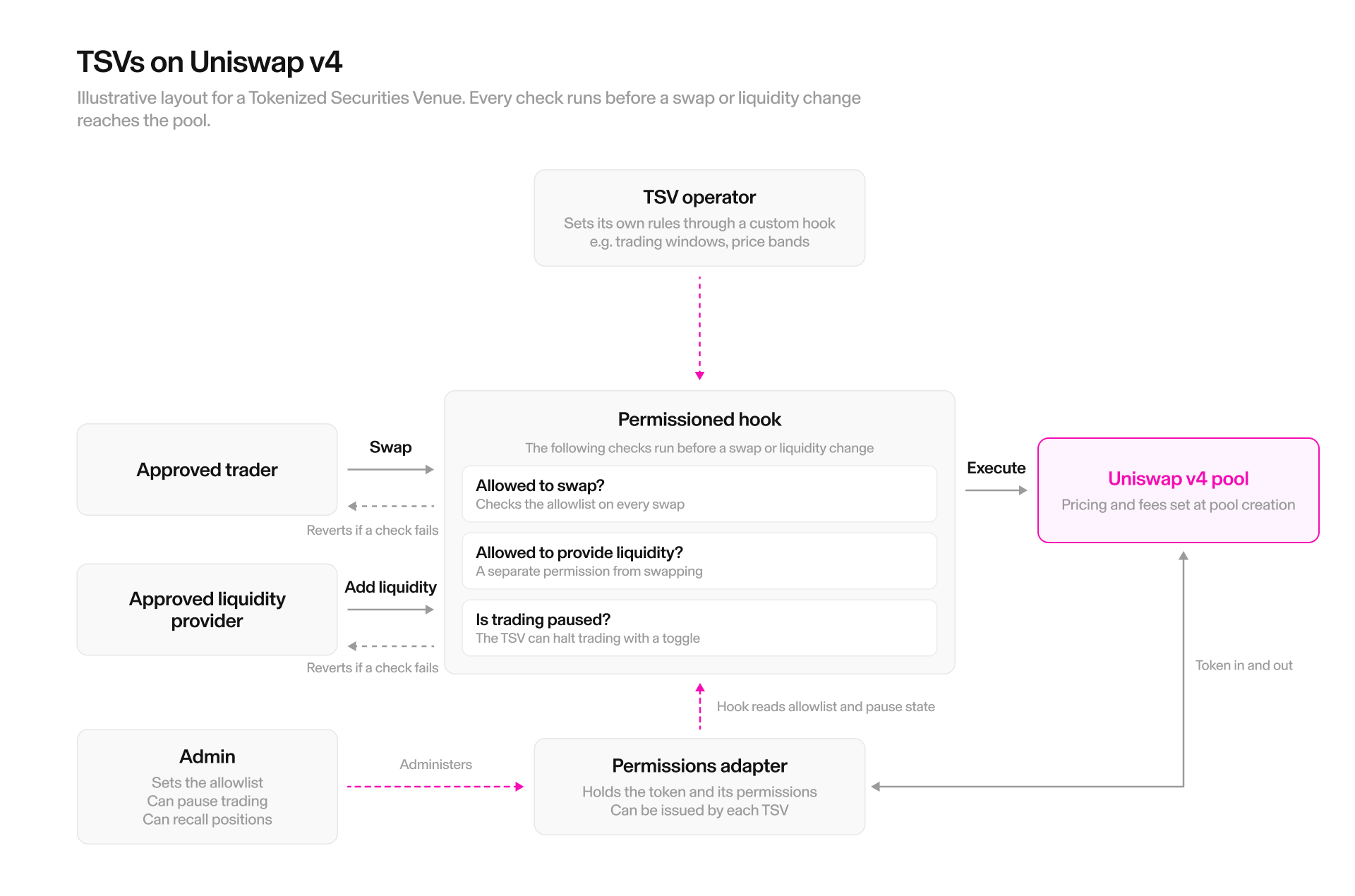
Uniswap v4 supports powerful market structure customizations through hooks, and our Permissioned Pools hook gives venues a foundation to build on.
Permissioned venues on Uniswap
Since launching in 2018, the Uniswap Protocol has processed over $4.5 trillion in volume across more than 30 blockchains. Its core contracts have never been exploited.
Uniswap v4 lets teams customize how pools work. Hooks are programmable logic that runs at set points, like before or after a swap. Execution and settlement still happen on the protocol. Operators decide who can trade, what can trade, and when.
Build with Uniswap Labs
Bringing stocks onchain is the start. The bigger shift is how markets get made, and who gets to make them. As the order evolves, we want to work with teams to figure out what these new markets look like in practice.
- TSV operators: We can walk you through using hooks for access, trading halts, and other pool-level controls
- Issuers: We can help you understand how tokenized stocks trade on an AMM, and what the Uniswap Protocol can and can’t do
- LPs: We can share research on how AMM liquidity behaves, and what changes in a permissioned pool
If you're exploring opportunities to build, issue, or provide liquidity under the Innovation Exemption, reach out.
Disclaimer: Uniswap Labs does not operate, control, or have a role in the operation of any tokenized securities venue. Any venue built using the Uniswap Protocol is independently operated, and its operator is solely responsible for its own design decisions, legal analysis, and compliance with applicable law, including the Innovation Exemption and its conditions. The Innovation Exemption is temporary, conditional, and subject to change. This post is for informational purposes only. It is not legal, financial, or investment advice, and it is not an offer or solicitation to buy, sell, or provide liquidity for any security or digital asset.