Aztec is building the first decentralized, privacy-preserving L2 on Ethereum. For its token sale, the team chose Uniswap’s Continuous Clearing Auctions (CCA), a fully onchain mechanism for transparent token auctions.
Aztec wanted their sale to be community-driven and permissionless, prioritize access, and result in real price discovery. CCA was designed with these principles in mind.
Aztec’s token sale
Aztec used CCA for its token sale in November 2025 ahead of its TGE in February 2026. Bidders could participate through multiple frontends, including Coinlist and Aztec's own custom interface. The sale also utilized ZKPassport alongside Predicate for identity verification. Aztec’s aim was to launch their token in a crypto-native way that prioritized permissionless, fair community access from day one.
Broad community participation
Historically, token sales have favored insiders. Fixed pricing and offchain allocations often create opaque processes where privileged players benefited from early access and favorable terms. By using CCA, Aztec’s auction parameters and outcomes were visible onchain, from start to finish. Every participant had access to the same information and could bid on equal terms. The results:
- 96% of bidders contributed under $10,000
- 28% of the total token supply went to wallets holding under $100,000
- The mean contribution was approximately $4,000
- ~17,000 participants verified their identities and submitted bids
- Users verified across 191 countries
Real price discovery without manipulation
CCA gave Aztec transparent price discovery without the typical manipulation risks. Unlike auctions where timing matters most, CCA spreads each bid across all remaining blocks and determines the clearing price based on total demand. Bidders compete on valuation, not speed.
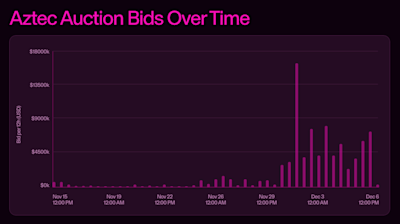 The mechanics are straightforward: bidders set a total budget and maximum price per token. As each block clears, bidders receive tokens if their price is competitive. Everyone pays the same clearing price, which carries forward from the previous block.
This structure naturally discourages gaming or botting. Early bidders get exposure to more of the auction, often secure better average prices, and there's no advantage to last-second sniping or gas wars. Because everyone had equal access to participate and contribute to price discovery, the auction uncovered real market demand. The onchain data confirmed this:
- No clear instances of sniping or automated price manipulation were detected based on onchain data
- Sale cleared at a price 60% above Aztec’s floor price
The future of liquidity bootstrapping and token distributions
Aztec’s sale shows what’s possible when token distribution moves fully onchain. By letting bids accumulate over time and clear based on total demand, the auction produced both broad participation and a market-driven price without relying on opaque processes or offchain coordination.
This design isn’t limited to token sales. Projects are already using CCA to bootstrap liquidity ahead of a TGE, giving markets a reference price and usable liquidity from day one. As more teams look for alternatives to traditional token launches CCA provides a foundation that puts DeFi principles first.
The framework is designed to be modular and extensible allowing teams to customize supply schedules, configure post-auction liquidity strategies, and integrate validation hooks to meet their specific needs. Aztec's sale demonstrates just one configuration within a much broader design space. CCA is a primitive, and teams are just beginning to explore what is possible.
Discover how Uniswap CCA can help your team design token launches and bootstrap liquidity.